Brown Rice & Avocado Sushi Rolls
Japanese food is fantastic for eating vegetarian, vegan and alkaline – and with just a few tweaks (gotta love the tweaks), sushi gets the alkaline makeover.
Tastes: fresh and clean, with creamy avocado, crunchy veg and nutty brown rice, dipped in Bragg.
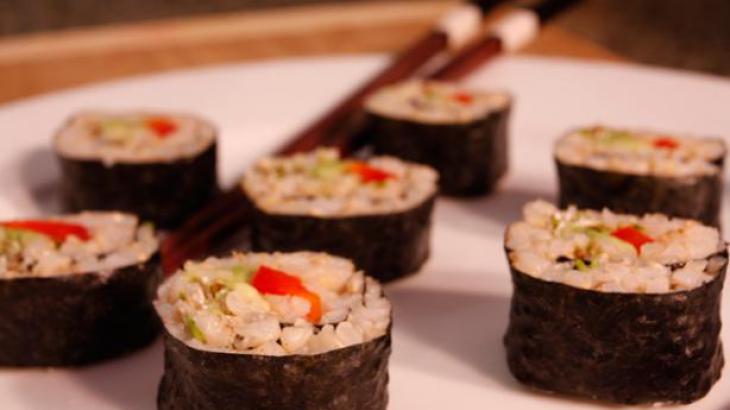
Fresh and raw are the order of the day
Since moving to Australia in 2005, I’ve eaten a LOT of Asian food – it’s really fresh and delicious out here: Thai, Japanese, Indian, Nepalese… All of these are fantastic for eating vegetarian, vegan and alkaline, none more so than Japanese, where fresh and raw are the order of the day!
The trick: mash a little avocado into the brown rice to give it that traditional ‘sticky’ feel of sushi rice. This way is much more alkaline!
Why you’ll love it
- Makes 4 rolls – 24 pieces.
- Manganese: more than a day’s worth a serve, from the brown rice.
- No sugar or vinegar in the rice – avocado makes it sticky.
- Easy to make once you’ve rolled the first one.
Good for
Copper, vitamin C, vitamin B6 and folate contribute to the normal function of the immune system.
Manganese, copper, vitamin C and riboflavin contribute to the protection of cells from oxidative stress. It also contains plant compounds with antioxidant activity, including beta-carotene.
Niacin, pantothenic acid, vitamin B6 and folate contribute to the reduction of tiredness and fatigue.
Manganese, magnesium, phosphorus and vitamin K contribute to the maintenance of normal bones.
Riboflavin, vitamin A and zinc contribute to the maintenance of normal vision.
Potassium contributes to the maintenance of normal blood pressure.
Tags use approved nutrient health-claim wording, for nutrients that give at least 10% of the Daily Value per serve. Plant compounds like these have no Daily Value, so we only say they’re there.
Key nutrients per serve
Contains: thiamin (58%), folate (47%), magnesium (41%), riboflavin (38%), phosphorus (36%), vitamin A (35%), selenium (35%), vitamin K (33%), zinc (33%), vitamin E (25%), potassium (24%), iron (18%) and calcium (5%).
Plant compounds: beta-carotene (about 3.4 mg).
% of US Daily Value for adults, per serve (half the recipe (2 rolls)). Estimated from USDA FoodData Central values for the ingredients as listed; cooking reduces some vitamins, so treat these as upper estimates. Nori uses raw laver values; includes 2 tsp tamari for dipping; excludes the optional tofu; anything over 100% shows as 100%+.
Brown Rice & Avocado Sushi Rolls
Ingredients
Equipment
Method
- Cook the brown rice following the packet instructions, then put it in a large bowl. Using a fork, mash in a quarter of the avocado to give it that ‘sticky’ feel of sushi rice.
- Slice all the vegetables. If you’re using tofu, quickly fry it in a little coconut oil and Bragg.
- Place a nori sheet shiny-side down on a clean surface. With wet hands, spread a quarter of the rice over half the sheet, leaving a 2 cm border along the edge closest to you.
- Spread a quarter of the remaining avocado across the centre of the rice. Lay a quarter of the pepper and cucumber over the avocado and top with a quarter of the carrot (and tofu, if using).
- Roll up firmly and brush the edge of the nori with warm water to seal. Repeat with the rest. Rest the rolls seam-side down for 5 minutes.
- Cut each roll into 6 pieces and serve with Bragg and chilli, if you like.
Swaps
- Quinoa works instead of brown rice, though it’s less sticky.
- More protein: add the tofu, or some shelled edamame.
- Other fillings: try spring onion, snow peas or mango.
Storing it
Best eaten within a few hours. Cover tightly and keep in the fridge if you’re making them ahead.
Good to know
- Tamari: choose one labelled gluten-free if you’re coeliac.
- Nori is rich in iodine, which is good in moderation; if you have a thyroid condition, check with your doctor before eating seaweed often.
Try next
The Alkaline Life Club has everything in the Recipe Club, plus coaching, live Q&A and a community to keep you going.
See the Alkaline Life ClubSources
Nutrient values: USDA FoodData Central, SR Legacy (brown rice 169703, nori (laver) 168458, avocado 171705, cucumber 168409, red pepper 170108, carrots 170393, tamari 174278). Plant compounds are named where the ingredient is a well-documented source; flavonoids follow the USDA Database for the Flavonoid Content of Selected Foods, Release 3.3. Daily Values: US Food and Drug Administration.