Tangy Sprout Salad
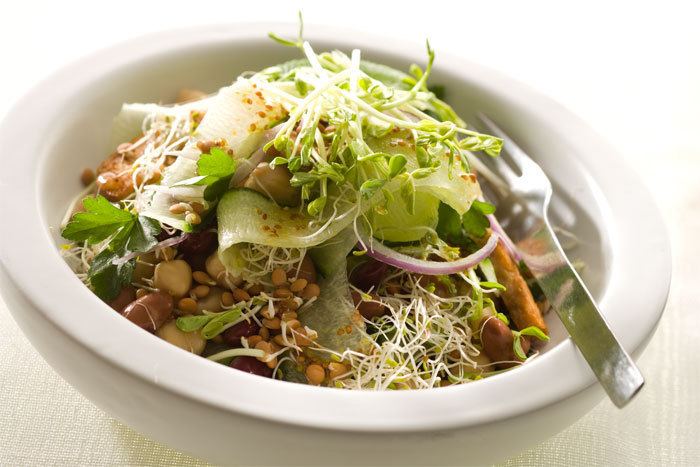
A crunchy, tangy, filling salad built on one of my favourite ingredients – sprouts – with a ginger, orange and lime dressing that’s to die for.
Tastes: crisp and tangy, with fresh sprouts and cucumber, sweet tomatoes and a zesty ginger, orange and lime dressing.
Big goodness in a tiny sprout
This is a crunchy, tangy and filling salad that uses one of my favourite ingredients: sprouts. Sprouts are so nutritious – they pack the goodness of a whole plant into a tiny sprout.
Broccoli sprouts are a great example. One study found that 3-day-old broccoli sprouts contained 10 to 100 times more glucoraphanin (the compound your body turns into sulforaphane) than mature broccoli.
You can play around with this salad and mix it up a bit, but the dressing is to die for!
Why you’ll love it
- Vitamin K: over one and a half days’ worth.
- Three kinds of sprouts for crunch.
- Plant protein and fibre from the chickpeas.
- That dressing: ginger, orange and lime.
Good for
Copper, vitamin C, folate and vitamin A contribute to the normal function of the immune system.
Copper, manganese, vitamin C and vitamin E contribute to the protection of cells from oxidative stress. It also contains plant compounds with antioxidant activity, including lutein, beta-carotene and lycopene.
Folate, vitamin B6, magnesium and riboflavin contribute to the reduction of tiredness and fatigue.
Protein contributes to the maintenance of muscle mass, and magnesium and potassium contribute to normal muscle function.
Vitamin K, manganese, magnesium and phosphorus contribute to the maintenance of normal bones.
Vitamin A, riboflavin and zinc contribute to the maintenance of normal vision. It also contains lutein and zeaxanthin, the carotenoids found in the macula of the eye.
Potassium contributes to the maintenance of normal blood pressure.
Tags use approved nutrient health-claim wording, for nutrients that give at least 10% of the Daily Value per serve. Plant compounds like lutein have no Daily Value, so we only say they’re there.
Key nutrients per serve
Contains: vitamin B6 (18%), magnesium (18%), riboflavin (15%), vitamin E (15%), potassium (14%), iron (14%), pantothenic acid (12%), zinc (11%), phosphorus (11%) and calcium (8%).
Plant compounds: lutein and zeaxanthin (about 4.1 mg), beta-carotene (about 2.8 mg), lycopene (about 1.7 mg), chlorophyll, gingerols from the ginger and citrus flavonoids from the lime.
% of US Daily Value for adults, per serve (half the recipe). Estimated from USDA FoodData Central values for the ingredients as listed, so treat these as upper estimates. Uses alfalfa values for the broccoli sprouts (USDA has no entry for them), romaine for the lettuce, tamari for the Bragg, lemon peel for the lime rind and half a can of chickpeas (about 120 g); anything over 100% shows as 100%+.
Tangy Sprout Salad
Ingredients
Equipment
Method
- Mix all the dressing ingredients together, with a little water if it’s too strong.
- Cut the cucumber into matchsticks and halve the cherry tomatoes. Roughly tear the lettuce leaves, and drain and rinse the chickpeas.
- Put everything in a large bowl, pour the dressing over and mix together. Enjoy!
Swaps
- Sprouts: any mix works – try radish, lentil or pea shoots too.
- Soy-free: use coconut aminos instead of Bragg.
- More filling: add half an avocado or some cooked quinoa.
Storing it
Best fresh. Make the dressing up to 2 days ahead and keep it in a jar in the fridge.
Good to know
- High in vitamin K. If you take warfarin or another blood thinner, keep your greens intake steady and talk to your doctor before eating more leafy greens than usual.
- Tamari: choose one labelled gluten-free if you’re coeliac.
- Raw sprouts: they carry a higher risk of food poisoning than most veg, so buy them fresh from a trusted shop, keep them in the fridge and rinse them well. If you’re pregnant or have a weakened immune system, cook them lightly or leave them out.
Try next
The Alkaline Life Club has everything in the Recipe Club, plus coaching, live Q&A and a community to keep you going.
See the Alkaline Life ClubSources
Nutrient values: USDA FoodData Central, SR Legacy (cucumber 168409, tomatoes 170457, baby spinach 168462, romaine lettuce 169247, canned chickpeas 173801, alfalfa sprouts 168384, mung bean sprouts 169957, tamari 174278, olive oil 171413, ginger 169231, orange peel 169103, lemon peel 167749, lime juice 168156). Plant compounds are named where the ingredient is a well-documented source; flavonoids follow the USDA Database for the Flavonoid Content of Selected Foods, Release 3.3. Daily Values: US Food and Drug Administration. Broccoli sprouts: Fahey, Zhang and Talalay, “Broccoli sprouts: an exceptionally rich source of inducers of enzymes that protect against chemical carcinogens,” PNAS 94 (1997): 10367–10372.